The Secret Language of the Familiar
A curator's essay
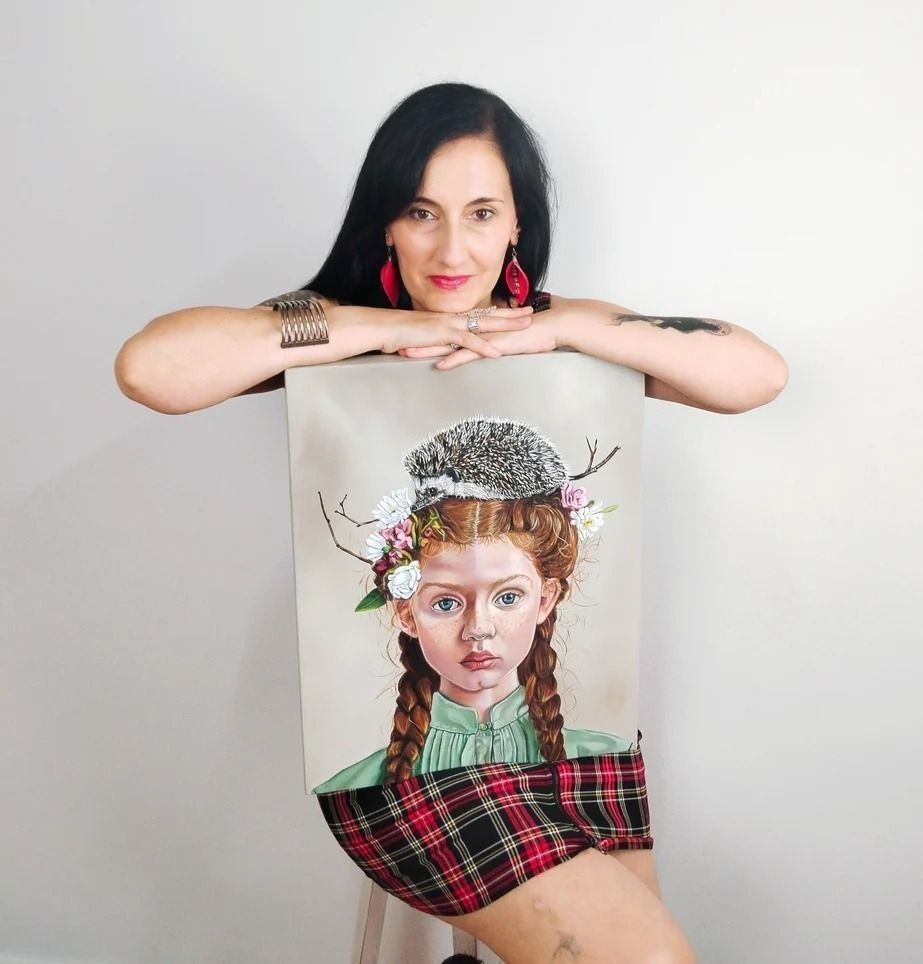
Mónica Conde’s figurative painting centers on childhood as a space of relation, observation, and symbolic construction. Her work rests not on anecdote, nor on portraiture as mere likeness, but on the building of scenes in which every visible element serves to measure, contrast, and direct the gaze. Children appear in the company of animals, domestic objects, garments of another era, clocks, and flowers — a vocabulary of the recognizable whose meaning lies in the precision with which presences, distances, and silences are arranged.
Faces, eyes, hair, and certain animal textures are rendered with a high degree of definition, while other zones dissolve into soft, atmospheric passages. This distribution orders the surface and sets the mode of reading: the eye enters through precision and stays for the relation between the finished and the open. Technique here is never a display of virtuosity; it is an instrument for graduating attention, proximity, and time.
The palette is sober and contained — ochres, earths, muted greens, warm grays, softened pinks and blues — so that a single accent, a ribbon, a flower, a small note of light, is enough to activate the whole. Light acts not as theatrical effect but as a condition of legibility: it models volume, separates planes, and establishes hierarchy without violence. These images are not seized in an abrupt instant; they are held in a stable, serene duration.
The animals — a fox, a magpie, a hedgehog, a hare, a squirrel — are never decorative additions. They function as counterpoints of scale, texture, conduct, and energy, introducing alertness, cunning, fragility, or stillness without a word. And the children are never passive emblems of innocence offered to the adult gaze: they appear concentrated, attentive, absorbed, sometimes smiling, sometimes grave. That oscillation gives them depth.
Period garments and carefully painted objects — cages, pocket watches, writing quills, small suitcases — displace each scene from any precise present into a terrain of controlled fiction, where era, memory, and imagination remain in suspension. The work avoids both easy sentiment and closed allegory; its meanings stay adhered to the material presence of things.
These are paintings that reward proximity and time. They demand no elaborate discourse to come alive, nor are they exhausted in a single glance; they ask the viewer to draw near, adjust distance, return to a detail and then to the whole. In a world of instantaneous images, Mónica Conde’s painting holds a slower, rarer kind of attention — and keeps it.
— Antonio Sánchez Castro, Curator